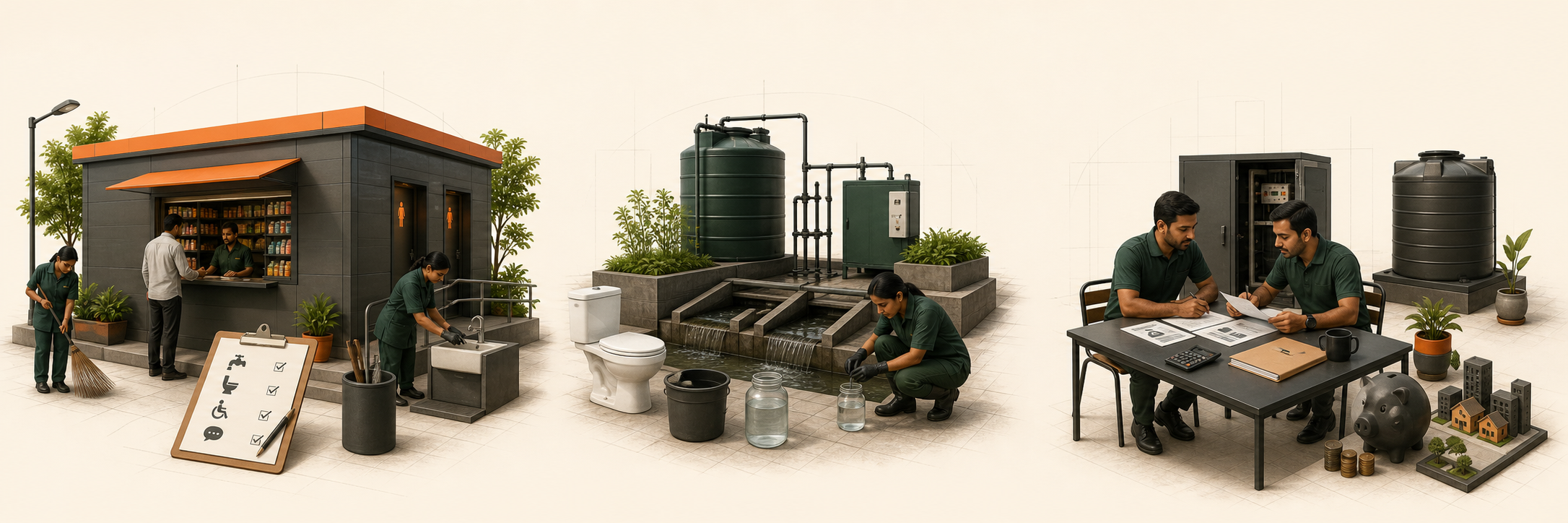
REVIEW TOPIC 08
What makes the model worth repeating?
Concept illustration · Design and operating principles from the presentation brief
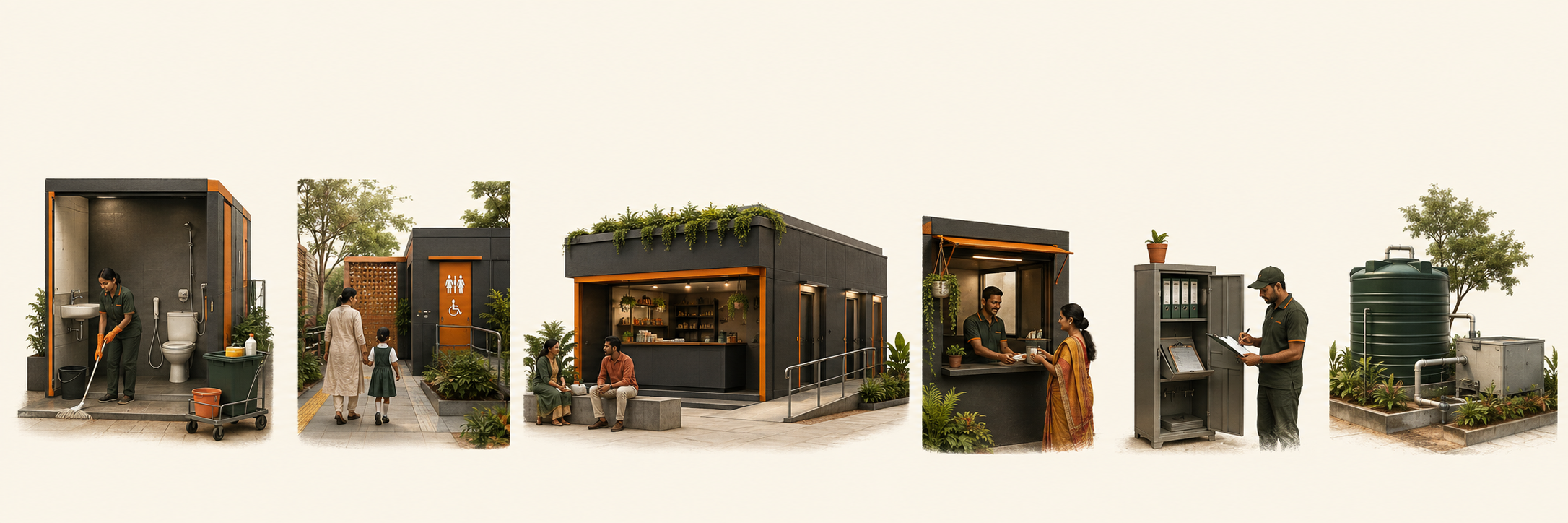
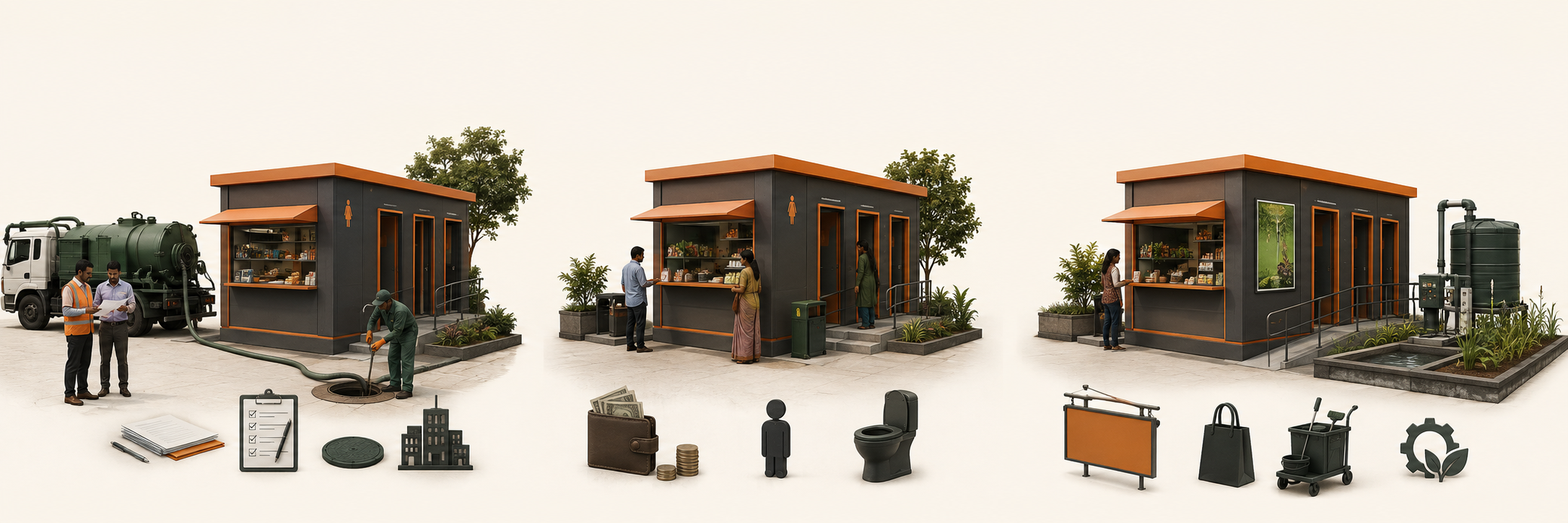
Design and operating principles from the presentation brief These are the values I mean. A usable toilet, a safe approach and privacy. A viable business. Someone checking the work. And a proper destination for the wastewater.
REVIEW TOPIC 11
ACCOUNTABILITY
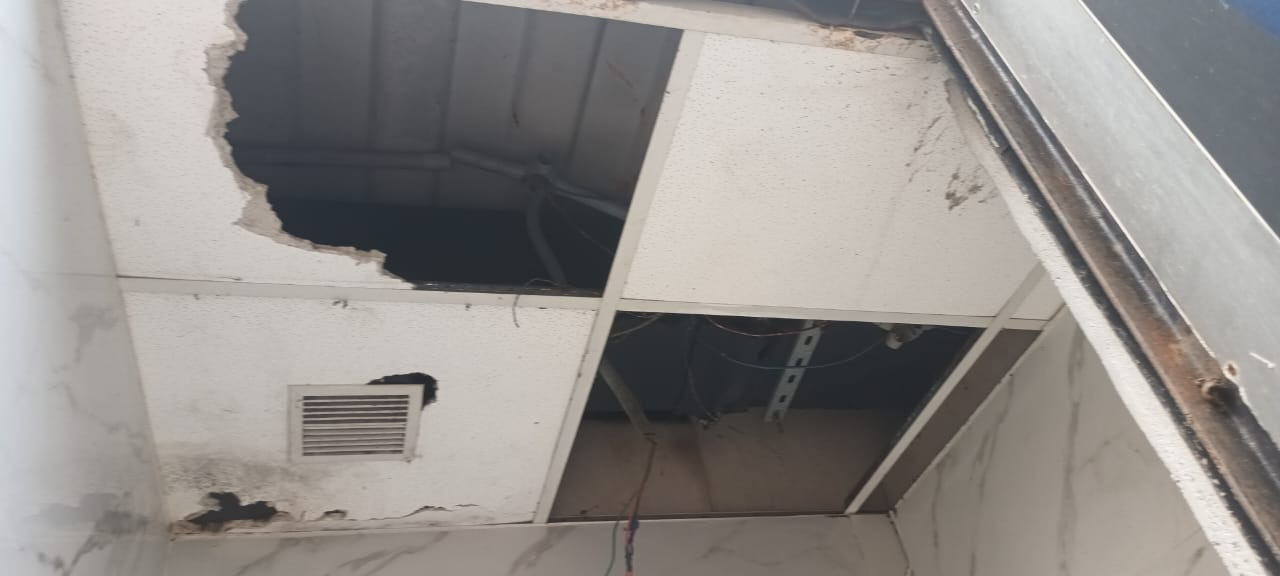
Dog Park, Gachibowli · Site status report, 13 Sep 2024, pp. 7 & 10 · Different camera views
Source: LOOCAFE LOOCAFE DOG PARK.pdf. The report is dated 13 September 2024; the damaged-ceiling image appears in the before section dated 9 September. The camera views differ, so these images do not establish a matched cubicle or a four-day repair guarantee.
REVIEW TOPIC 15
Open the record. Inspect the photographs.
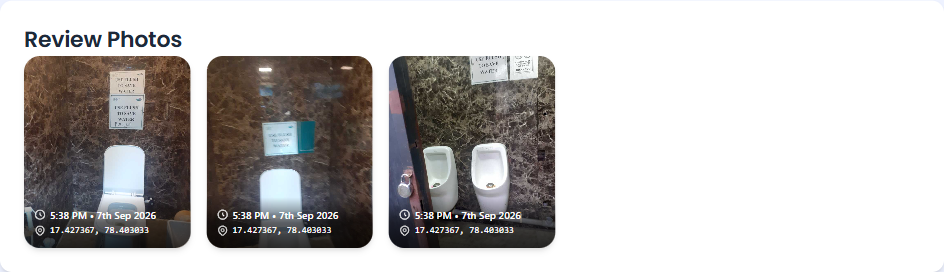
Actual dashboard.loocafe.com capture · LC_ID_023 evening review, 7 Sep 2026 · Submitted record, not independent verification
Authenticated dashboard photo-review panel for LC_ID_023, Rainwater LooCafe, Jubilee Hills. The displayed photographs include time and location. Submission metadata is not independent verification of cleanliness or completion.
REVIEW TOPIC 30
But where does the flush go?
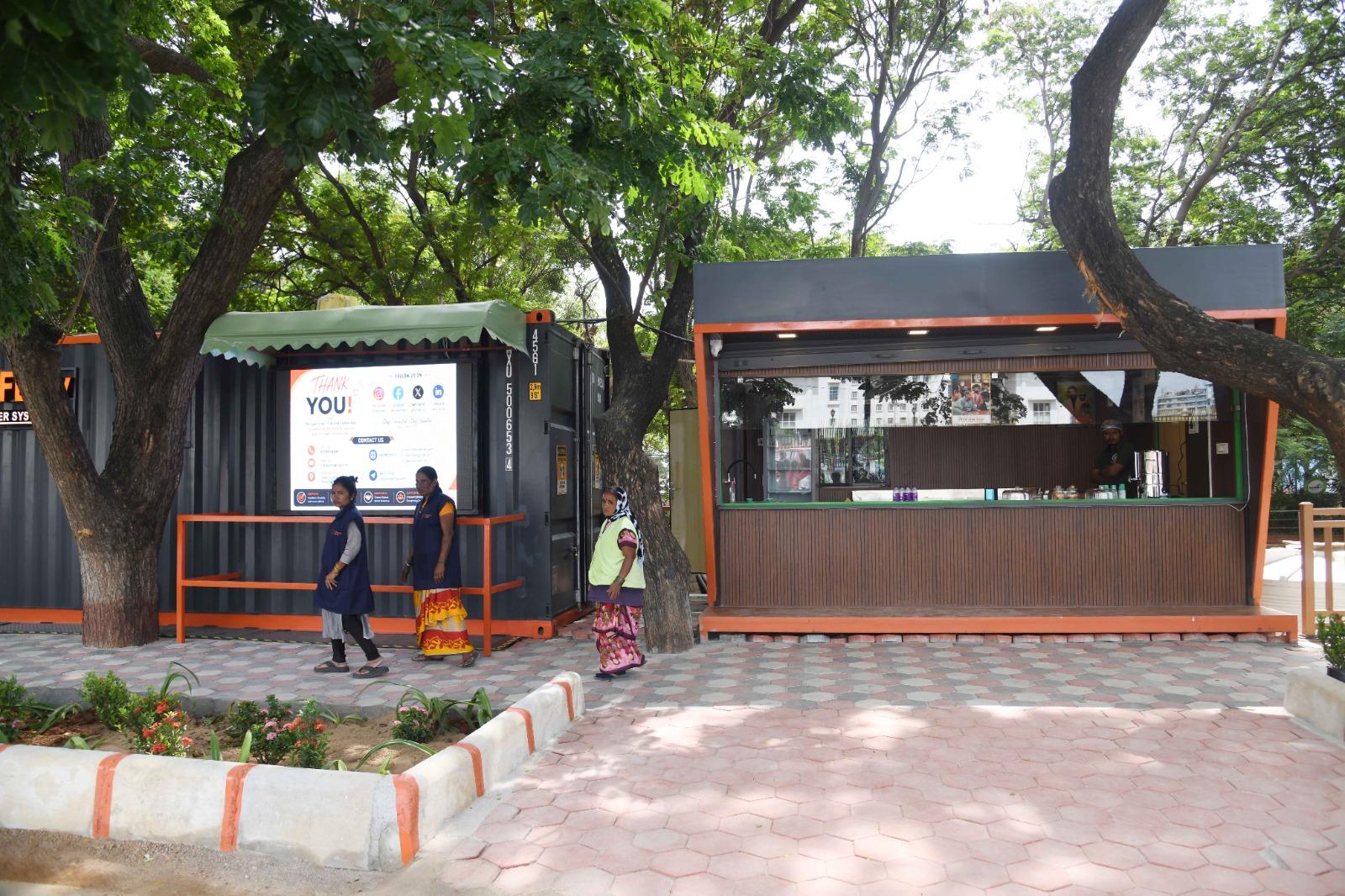
CPCB, March 2021, Fig. 3.1: 2020 inventory · Ixora relocation letter, 11 Apr 2023: company-reported case
National figures: CPCB National Inventory of STPs, March 2021, Figure 3.1 / printed page 12, describing the 2020 inventory; values rounded. The NTR Samadhi Mini example is reported in an Ixora letter dated 11 April 2023: relocation ten metres away, with no drain connection at the new location. This is a company account, not an independent inspection or evidence that ReFlow was later installed there. The two measures describe different scopes and are not combined into a performance claim.
REVIEW TOPIC 35
Follow the water.
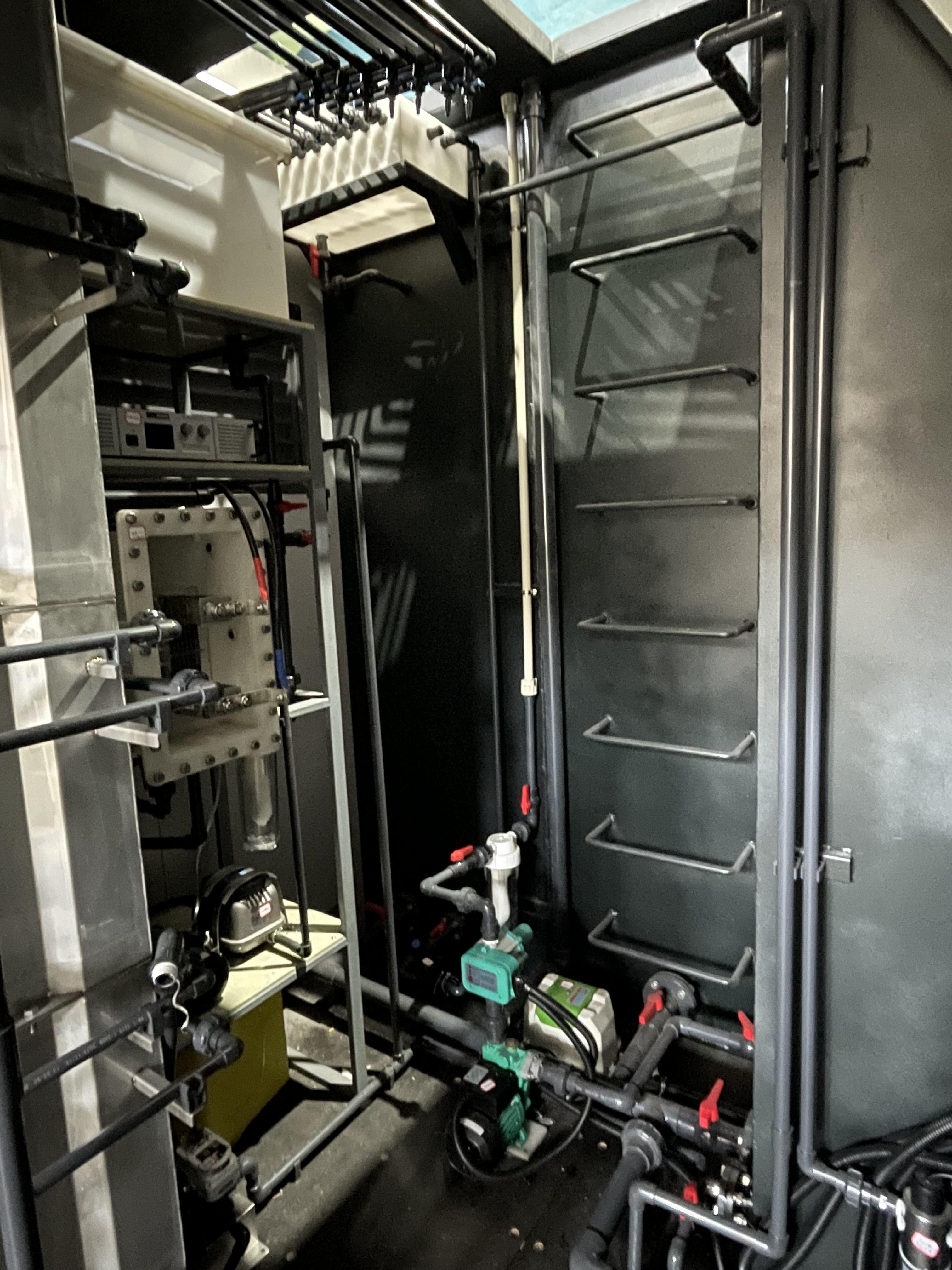
BCRT O&M manual, Aug 2024, pp. 6–8 (printed) · Simplified selected configuration
BCRT O&M manual, August 2024, printed pages 6–8. The manual describes a 40-foot, seven-cubicle configuration. The functional sequence is collection/regulation, biological treatment, further treatment/disinfection and non-potable flushing reuse. Exact installed model equivalence remains unverified.
REVIEW TOPIC 37
The engineering is in the operating limits.
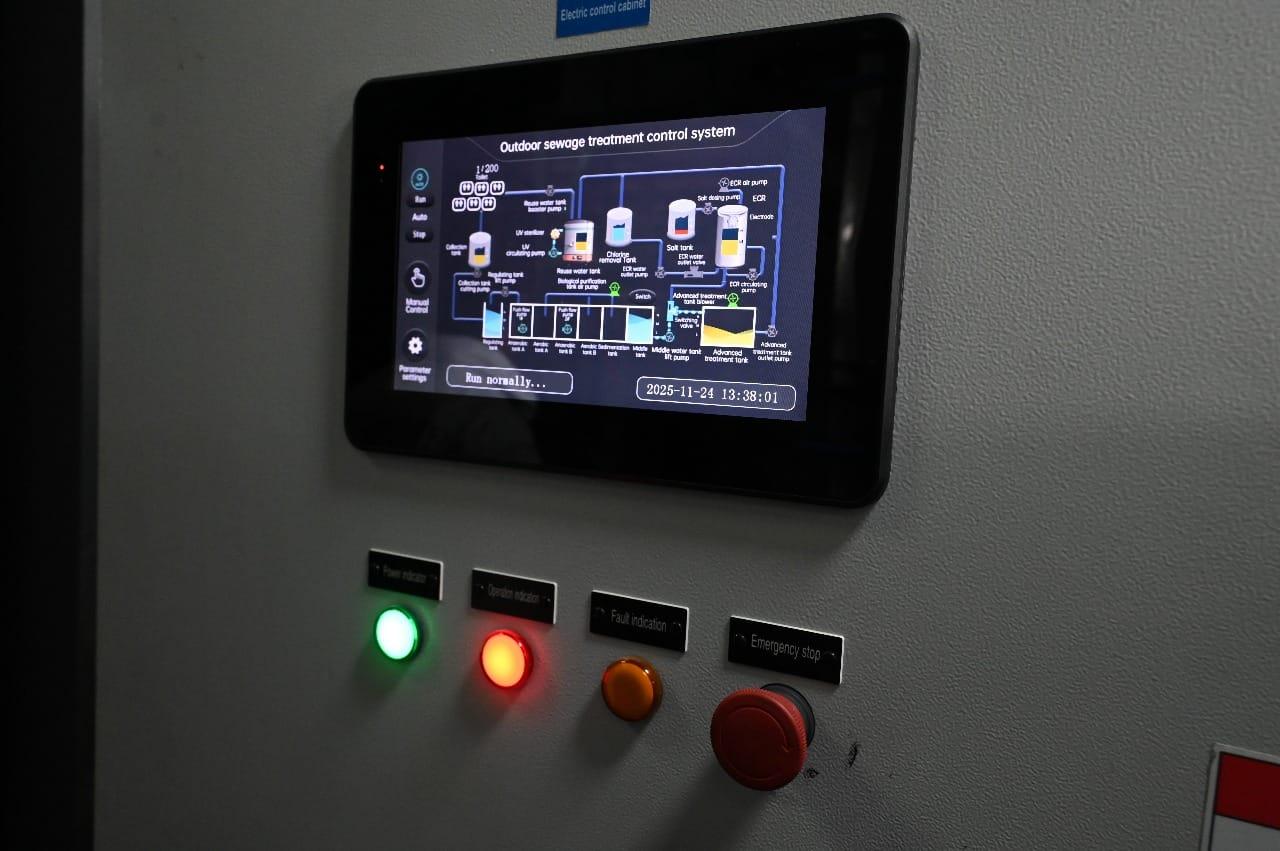
BCRT O&M Manual, Aug 2024, printed pp. 12, 14–15, 23 · Documented configuration; actual control-panel photo
BCRT O&M manual, printed pages 12, 14–15 and 23. Commissioning, progressive loading, interlocks and treatment-compatible cleaning are operating responsibilities. A real control-panel photograph does not itself prove effluent quality or certification.
REVIEW TOPIC 39
BCRT: read the specification before sizing the site.
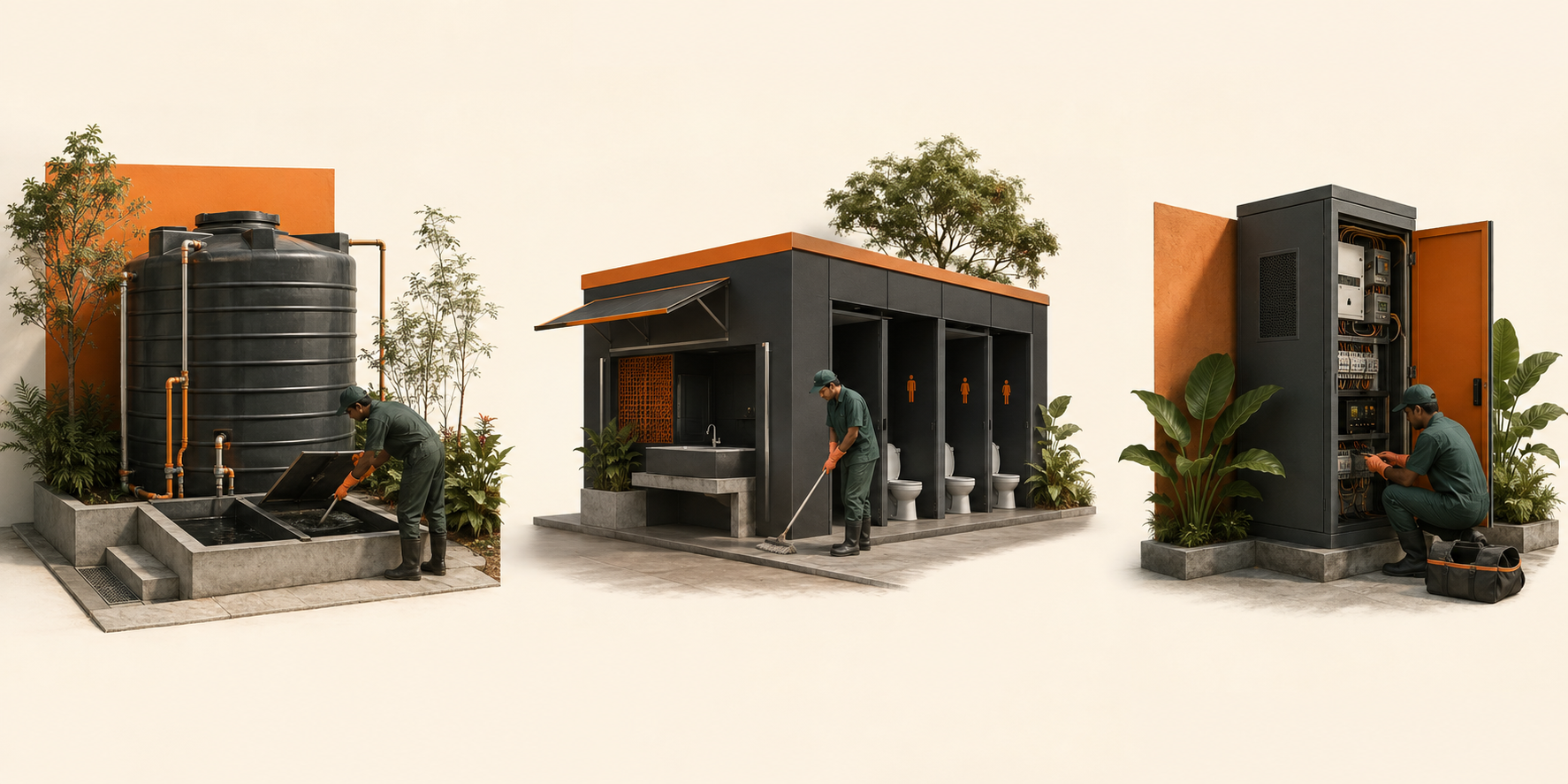
Concept illustration · BCRT O&M Manual, Aug 2024, cover and printed p. 3; reference configuration only
BCRT O&M Manual, Aug 2024, cover and printed p. 3; reference configuration only These numbers belong to the forty-foot, seven-cubicle manual. They cannot be used as the rating of a different installed unit. Installed power is not daily energy use. Match the equipment schedule and commissioning record before quoting site capacity.
REVIEW TOPIC 40
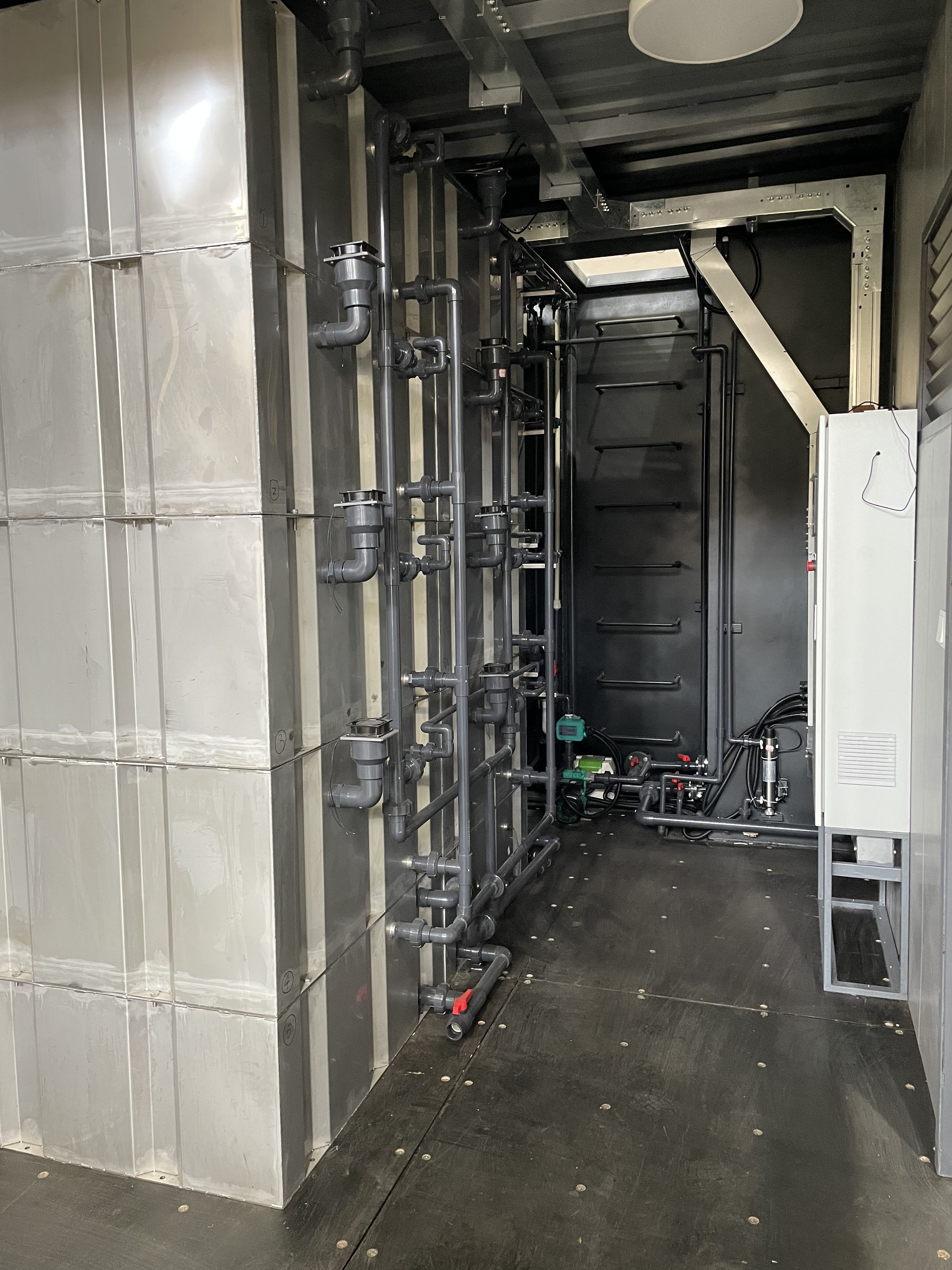
BCRT maintenance needs access and trained people.
Original factory photograph; BCRT O&M Manual, printed pp. 2, 18–23
Original factory photograph; BCRT O&M Manual, printed pp. 2, 18–23 The service passage is not leftover space. Someone must inspect equipment, reach valves and replace failed components. Cleaning the cubicle and maintaining the plant are linked jobs, with different skills.
REVIEW TOPIC 41
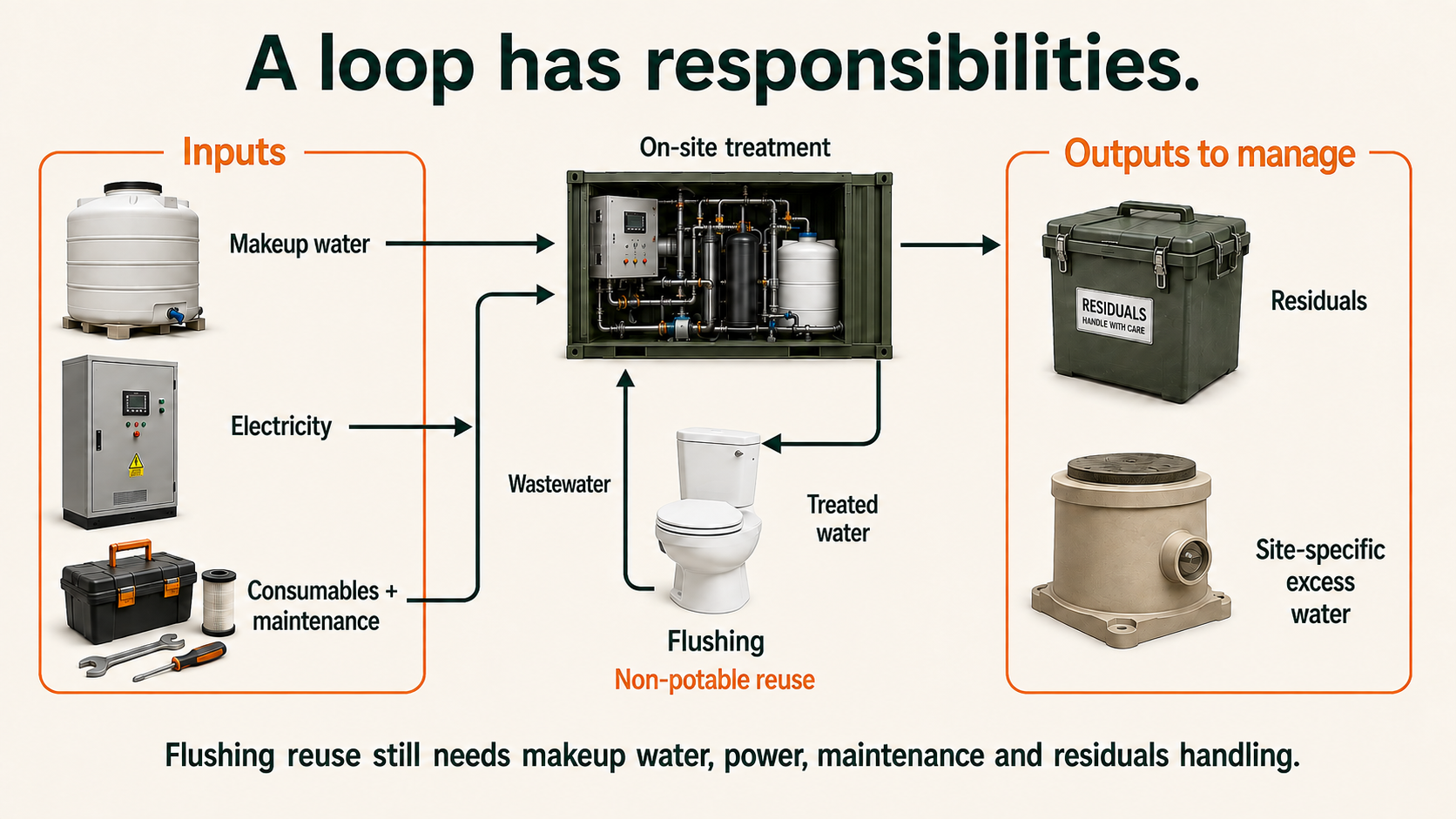
A loop has responsibilities.
Concept illustration · BCRT O&M manual; non-potable reuse and managed outputs, not an as-built diagram
A conceptual boundary for the documented reuse system: makeup water, power, consumables and residuals still require management. The return arrow means non-potable flushing reuse, not drinking-water delivery or zero residuals.
REVIEW TOPIC 42
Measure the difference.
400 people/day: speaker-reported pre-launch activity; period and count method unverified
Around 400 people/day is the speaker’s pre-launch activity report. Its period and counting method remain unverified. It is not a hydraulic design capacity, flush count or measured water-saving figure. Impact requires aligned water, energy, availability and quality records.
REVIEW TOPIC 44
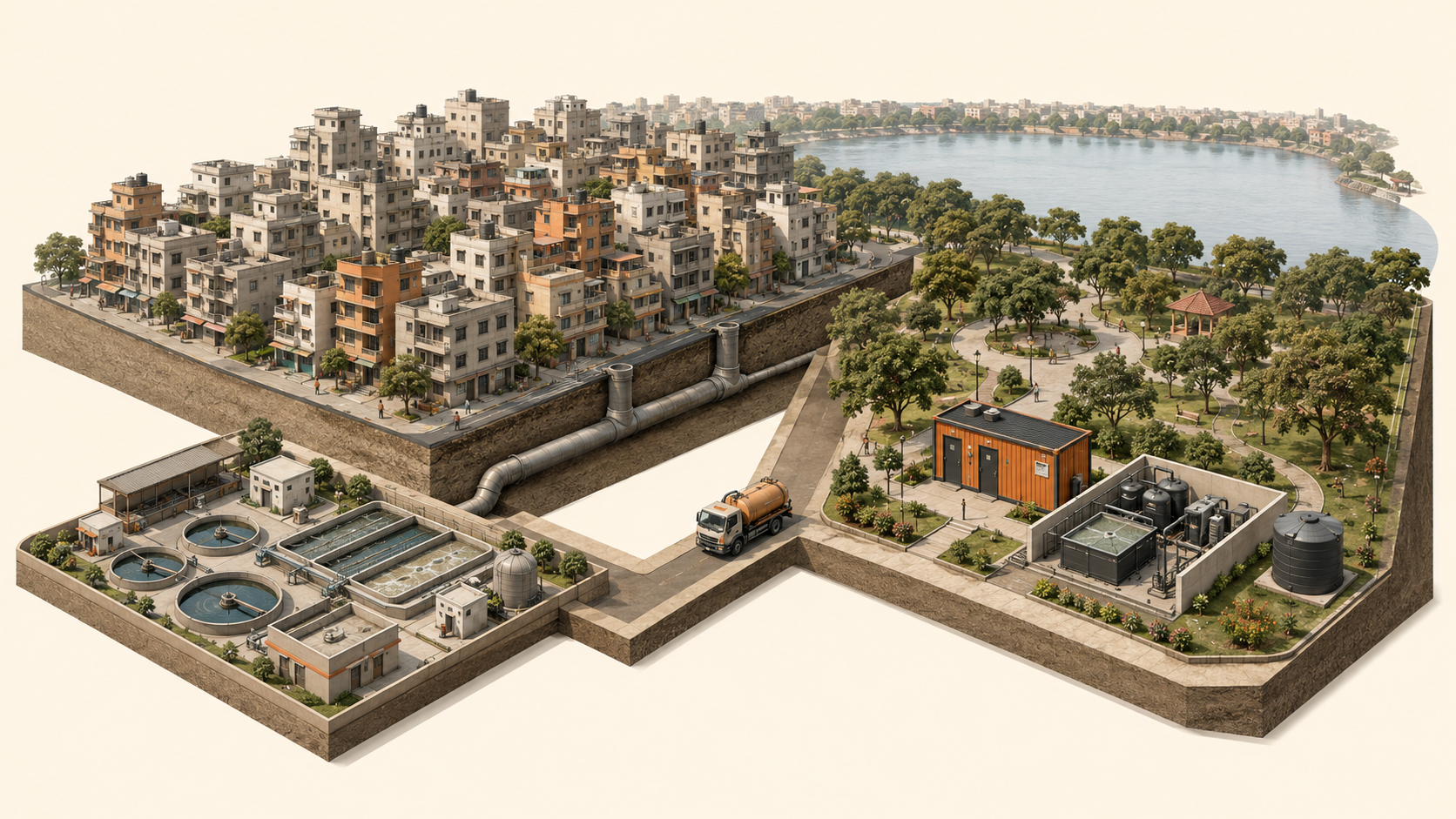
Citywide sanitation uses more than one treatment route.
Concept illustration · NIUA handbook, 2019, pp. 19, 23–27, 40–43 · Not a city map or piping plan
NIUA, Non-Networked Sanitation Systems for India, 2019 workshop handbook. The handbook distinguishes sanitation-chain functions and includes local treatment and co-treatment cases. It supports choosing appropriate routes, not a ReFlow product ranking.
REVIEW TOPIC 46
The market: different ways to fund and run a toilet.
Concept illustration · Analytical comparison: MoHUA sanitation guidance, NIUA and company model documents
Analytical comparison: MoHUA sanitation guidance, NIUA and company model documents This compares operating approaches, not brand rankings. Municipal and pay-per-use toilets can work well. Retail and advertising can support access. ReFlow adds treatment duties; it still needs an operator and maintenance budget.
REVIEW TOPIC 47
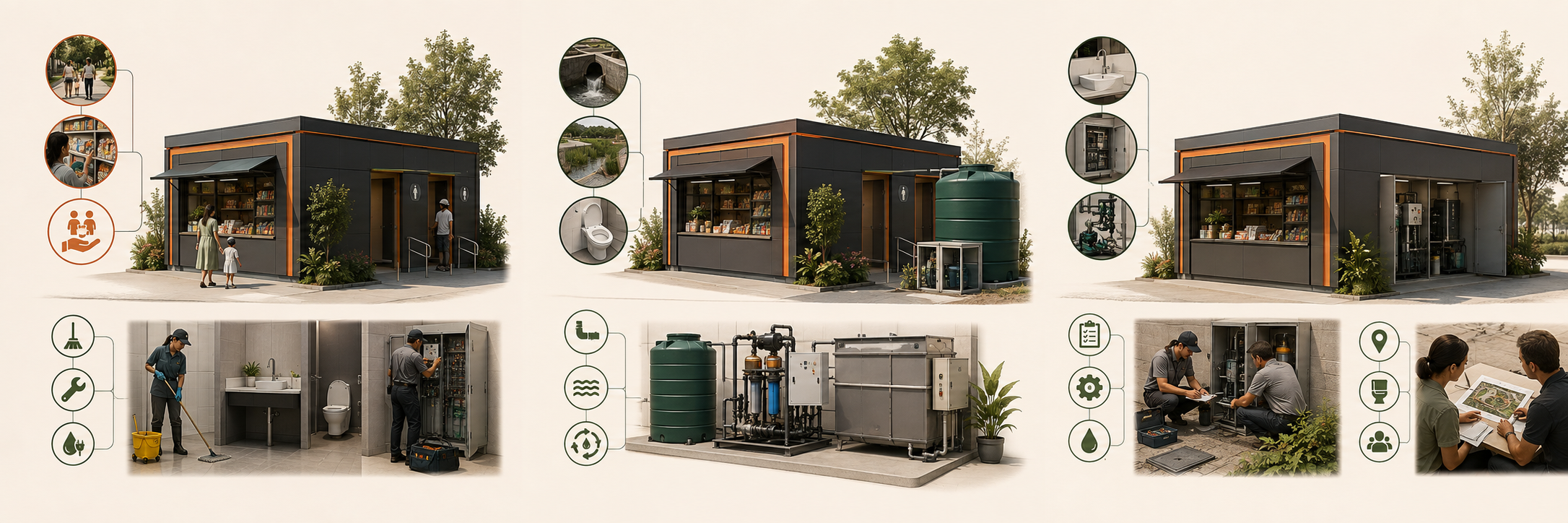
Standard LooCafe and LooCafe with BCRT.
Concept illustration · Company model explanation and BCRT O&M Manual; no comparative performance trial
Company model explanation and BCRT O&M Manual; no comparative performance trial Standard LooCafe is the facility and business model. BCRT adds treatment. Both need daily care. The plant also needs commissioning, sample results, technical maintenance and a residuals route. Choose the configuration for the site.
REVIEW TOPIC 48
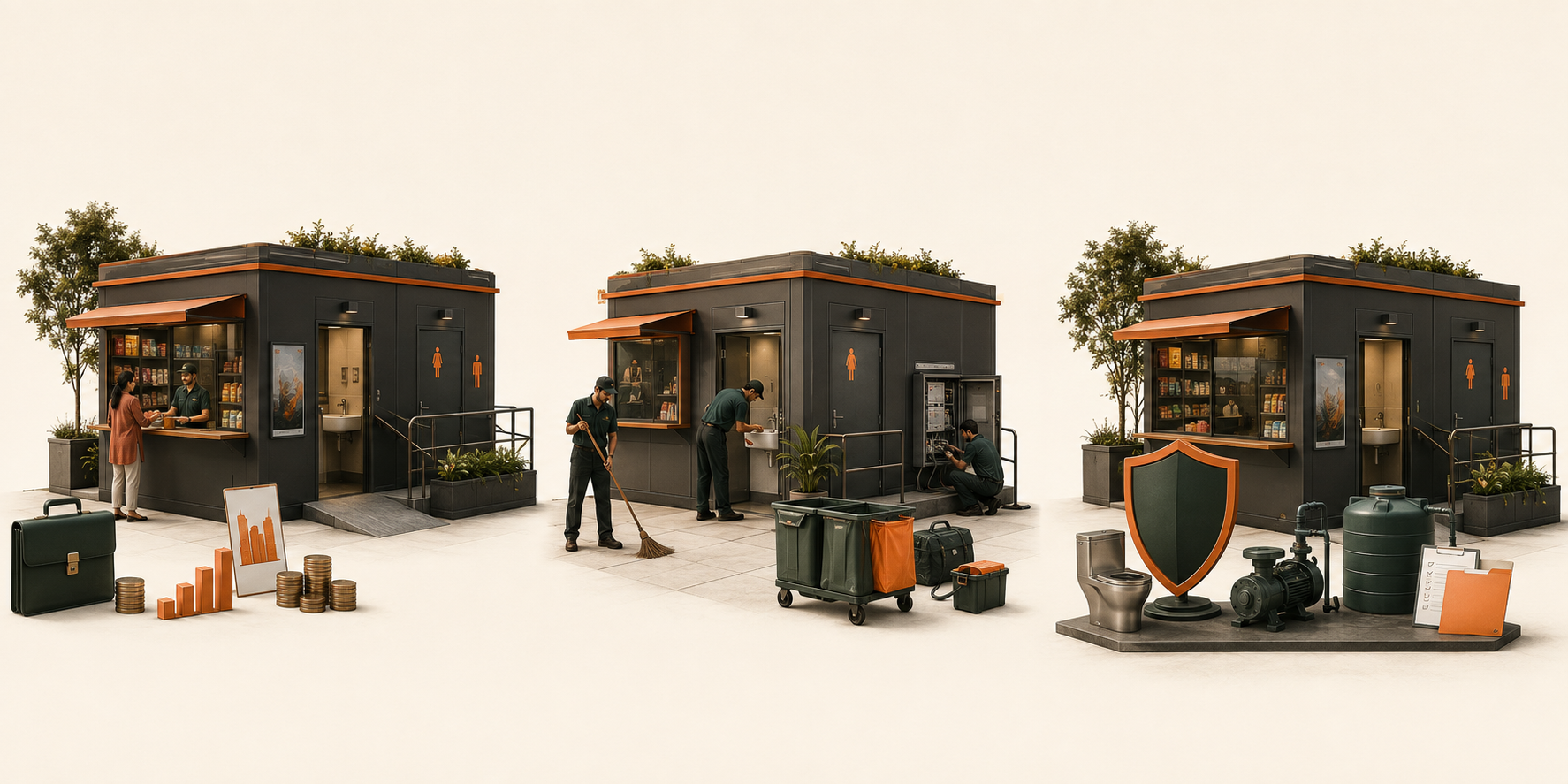
The business has to pay for the service.
Concept illustration · Commercial planning framework; no site-specific profit or return claimed
Commercial planning framework; no site-specific profit or return claimed Sales are not profit. Look at what remains after running the shop. Add committed advertising or service payments. That income must cover toilet operation, plant care and a replacement reserve. Build the business case site by site.
REVIEW TOPIC 49
PPP: agree who provides what.
Concept illustration · DEA PPP guidance; illustrative allocation, not agreed Karnataka terms
DEA PPP guidance; illustrative allocation, not agreed Karnataka terms PPP means public-private partnership. Name what each side provides, who carries each risk, how the service is paid for, and what happens when standards are missed. Agree the allocation for the actual project.

REVIEW TOPIC 50
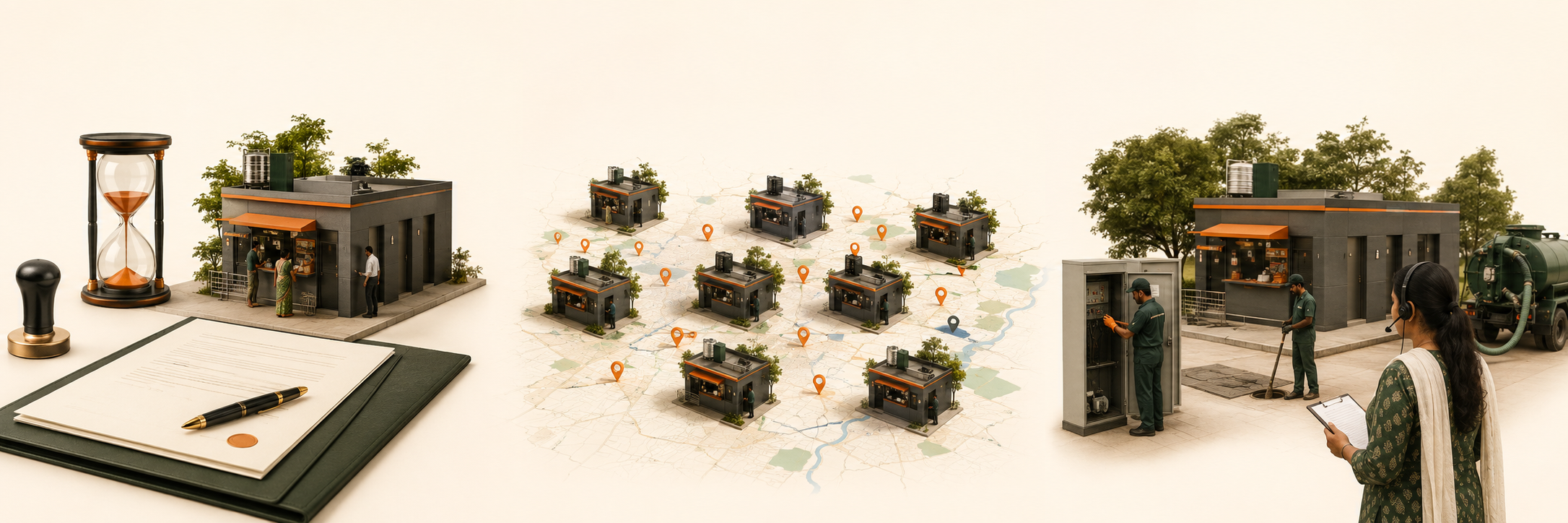
A contract can cover years of service.
Concept illustration · GHMC experience certificate, 7 Aug 2020, archived 07-08-2020.pdf
GHMC experience certificate, 7 Aug 2020, archived 07-08-2020.pdf The August 2020 GHMC certificate describes a fifteen-year concession including operation and maintenance. It describes thirty-six locations but lists four completed. This is evidence of a long-term structure, not a current deployment count.
REVIEW TOPIC 52
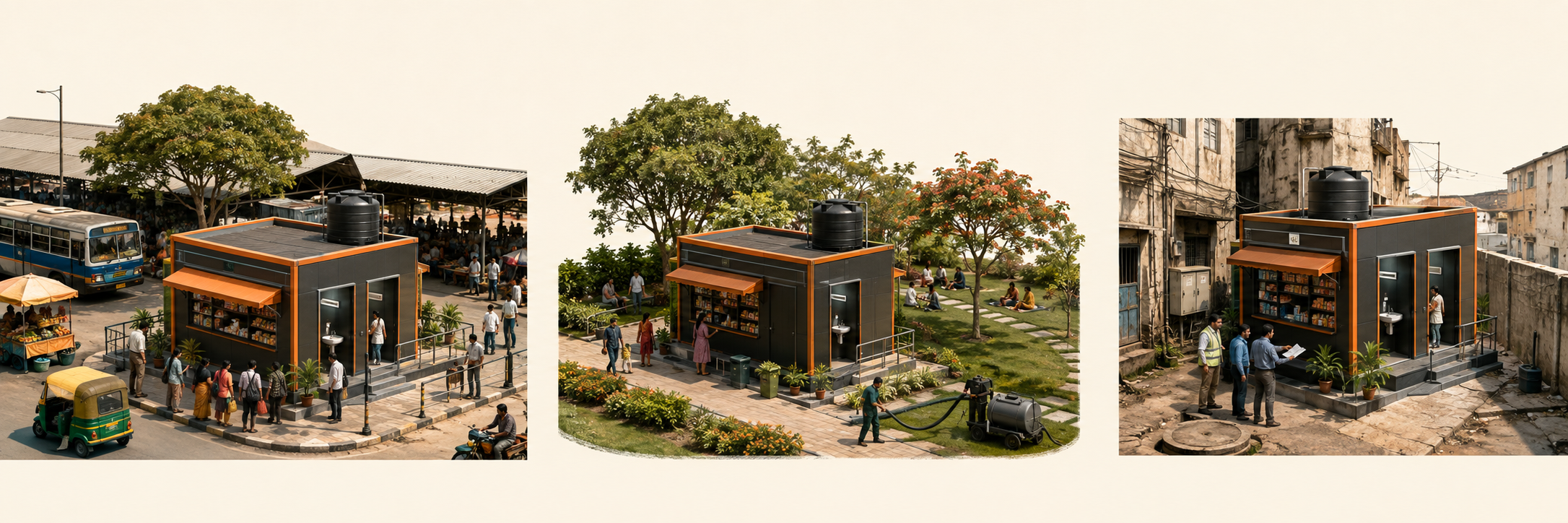
Karnataka: start with sites that need a service.
Concept illustration · Karnataka proposal; site categories, not confirmed sites or approvals
Karnataka proposal; site categories, not confirmed sites or approvals Start where a usable toilet is missing or unreliable. Check demand, access, utilities and the wastewater route. Some sites suit Standard, some Mini, and some may justify local treatment. Do not prescribe the same box everywhere.
REVIEW TOPIC 53
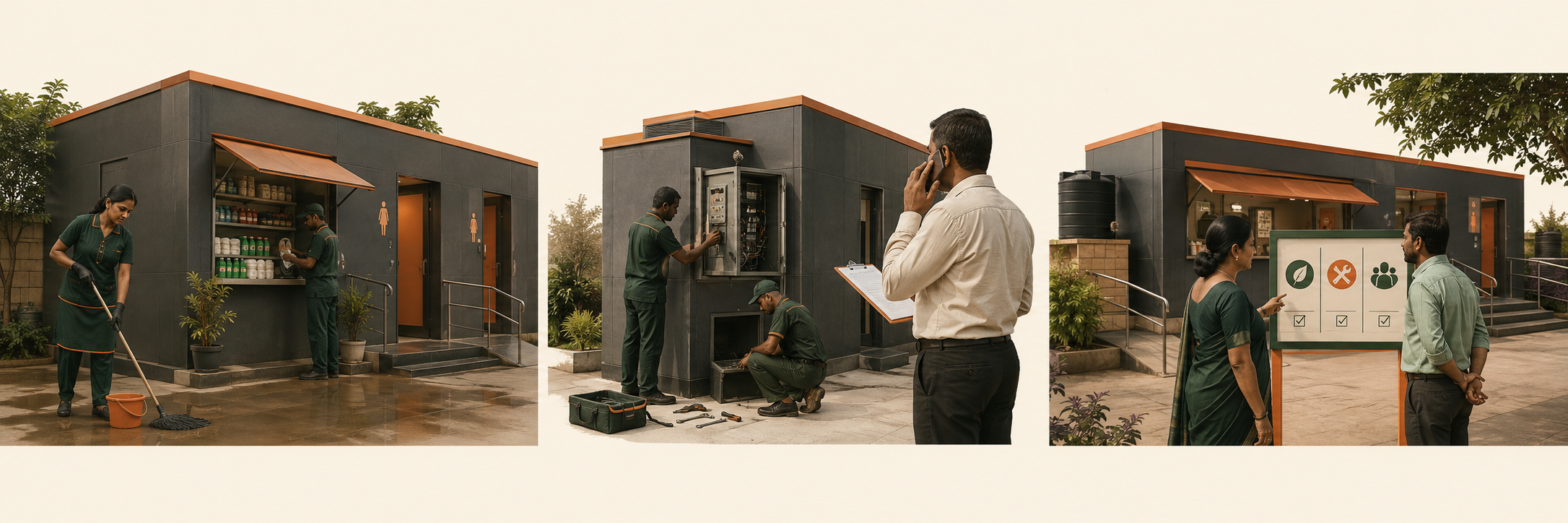
Karnataka: put the operating duties in writing.
Concept illustration · Proposed service requirements; subject to procurement and agreement
Proposed service requirements; subject to procurement and agreement Who opens it? Who cleans it? Who handles a failed pump? Put those duties in the agreement, alongside escalation, inspections and replacement funding. That makes accountability something we can act on.
REVIEW TOPIC 54
Karnataka: measure the pilot before expanding.
Concept illustration · Pilot evaluation proposal; no completed results or rollout commitment implied
Pilot evaluation proposal; no completed results or rollout commitment implied The first sites must answer the questions for the next ones. Was the toilet usable? Did treatment meet the requirement? What did it cost? Keep records over the same period, then choose where to expand.